
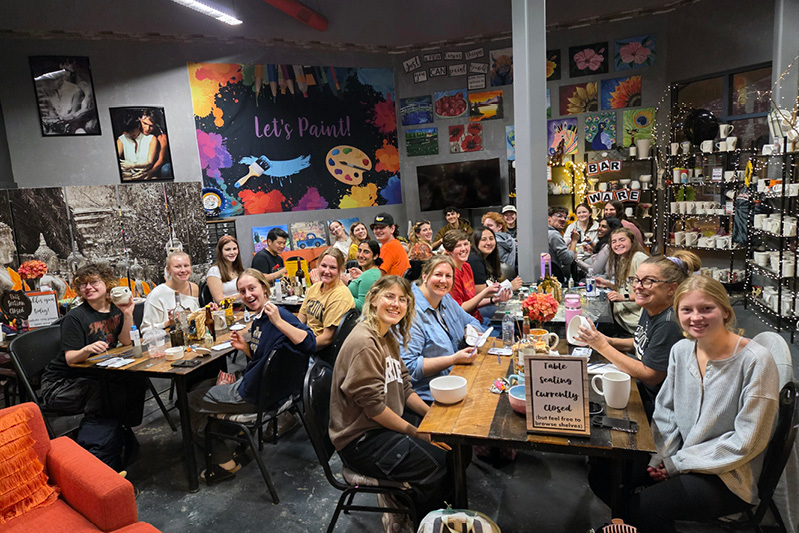
As Purdue continues to innovate in higher education, the university’s learning communities stand out as dynamic environments where academic experiences and residential life intersect.
“Research shows that when there aren’t connecting experiences, people disengage. Integrating the living and academic experience provides that common link,” says Bryan Austin, residential academic initiatives and Executive in Residence director. “When it comes to the lived experience, it fills in more of the picture so that students can keep the skills longer and apply them in better ways.”
This semester, the introduction of several new learning communities offers students a wider range of diverse and meaningful opportunities, further enhancing their ability to engage, connect and grow.
Community-Based Accelerator for Leadership Transformation (COBALT) is a new section within the Honors College, created through collaboration with University Residences, allowing leadership-minded students to live together on the same floor, take courses together and participate in events with the Executive in Residence program.
The new Science Innovation Learning Community is an initiative by the College of Science. It emphasizes entrepreneurship and advancements in science-related technologies, focusing on technology and biology rather than just business or economics.
Another community is the Art of Attention, the first learning community partnership with the Cornerstone Integrated Liberal Arts program. It’s championed by Christopher Yeomans, the Justin S. Morrill Dean of the College of Liberal Arts, and it aims to help students improve focus and address mental health challenges related to technology through philosophy and Cornerstone courses.
“They’re looking at helping students cope with the mental health challenges around technology and focus, because everybody’s scrolling,” Austin says. “Doomscrolling is real! Cornerstone involves a lot of reading, but it can be a challenge when students aren’t used to sitting down for more than a couple minutes.”
In addition to the new learning communities, University Residences has also implemented administrative and structural changes to improve students’ experience. Students can now renew or apply for learning communities within the housing application, which greatly simplifies the process. Event collaborations between learning communities are set to increase, further supporting their multidisciplinary approach.
Austin says that connection is one of the most important elements of learning communities. Peer-to-peer learning and peer networking need space to flourish as it becomes harder to form valuable connections with other students in class time alone.
Since the communities aren’t necessarily major-specific, students can collaborate and form these connections with others from different majors and colleges. This multidisciplinary approach provides hard and soft skills they can take with them beyond college.
“When you think about innovation, you need different people — and they have to learn how to work together,” Austin says. “Getting students used to working with people from different academic disciplines while they’re pursuing their degree prepares them to do so when they enter their career.”
One of the most unique elements of learning communities is the ability for both faculty and students to adapt course materials and experiential opportunities to meet students where they are and address current challenges.
“These faculty members are passionate explorers. They get super excited about learning from students and adapting course materials,” Austin says. “We don’t know what experiential learning opportunities we’re going to pursue outside the classroom. We have ideas, but once they know the students, then they can choose the experiences that will benefit them.”
By integrating academics, residential life and experiential learning, Purdue’s learning communities empower students to build valuable connections, develop multidisciplinary skills and adapt to evolving challenges. They can both excel during their studies and gain a competitive edge in their professional careers.